A Julia bulb, and what the Mandelbulb is a catalogue of
Sun 22 Nov 2026, 23:31
I've been rendering the Mandelbulb — the famous 3D fractal — and the Mandelbox, and posting live viewers for both. The thing that finally made the bulb click for me was building its twin: a Julia bulb.
Here's the idea. The bulb is built by iterating a point and asking does it run away to infinity? The classic iteration is:
z → z⁸ + cwhere z starts at the point in space you're testing, and c is a fixed number. The set of z that never escape is the fractal. In the Mandelbulb, c is the point you're testing and z starts at the origin — so every location in 3D is its own little experiment, and the shape is the map of which experiments stay bounded.
A Julia bulb flips it. Fix c, and let z range over all space. The points that stay bounded, for that one c, form a Julia set. Do this in 3D with z⁸ and you get the shape below. The punchline: the Mandelbulb is the catalogue of every Julia bulb — each point inside the bulb is a seed c, and the Julia shape that seed produces is its entry in the catalogue.
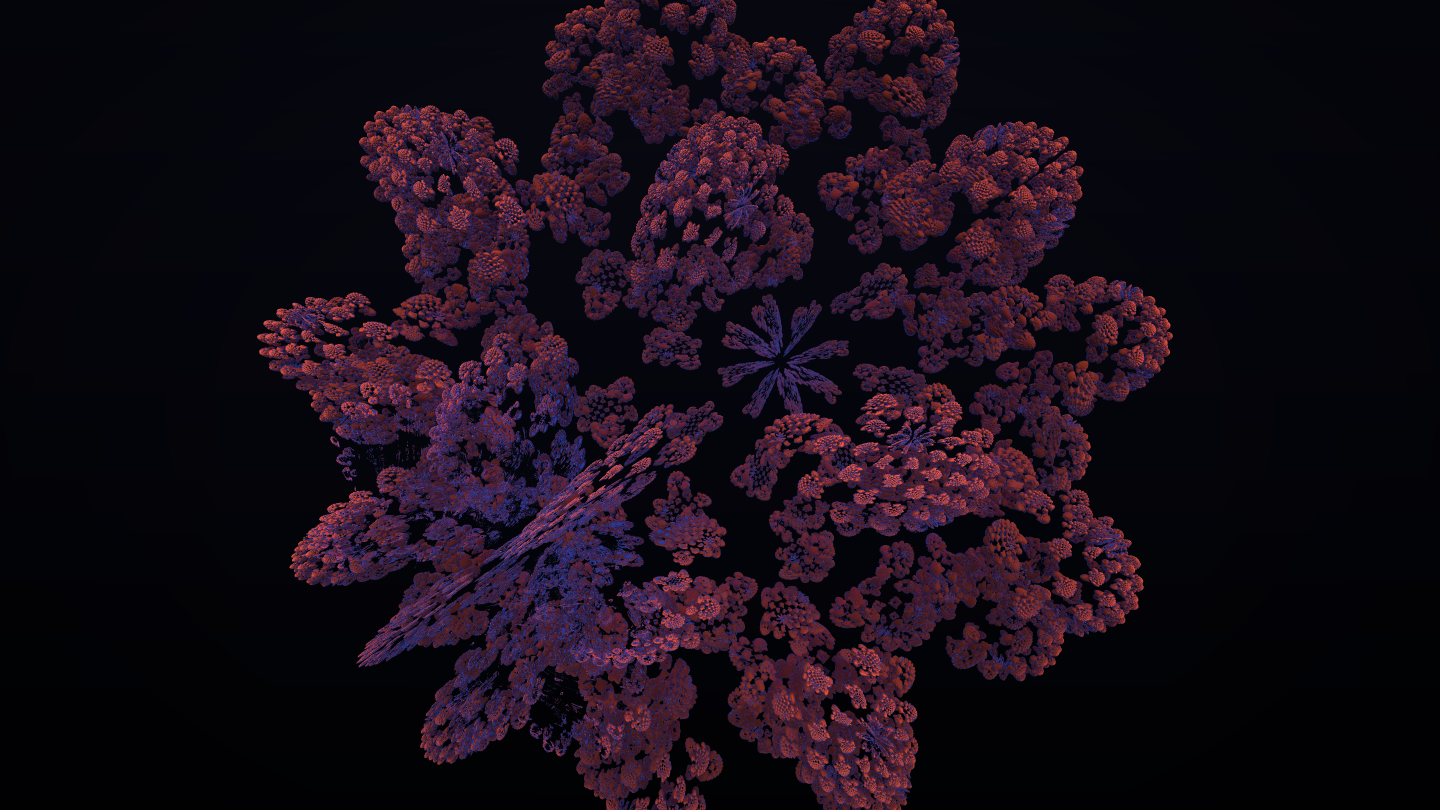
Julia bulb, seed c = (0, 1.05, 0)
That's the hero: a starburst of coral and violet with a six-pointed star at its heart, one slider-setting away from calm. I built it by taking my existing z⁸ raymarcher and changing one idea — the iteration now seeds from the point itself and adds a fixed seed each step, z = z⁸ + c, instead of seeding from the origin and adding the location. Same distance estimator, same palette, same camera.
The seed is the whole personality
The single vector c decides everything. A few seeds, marched with the identical renderer:
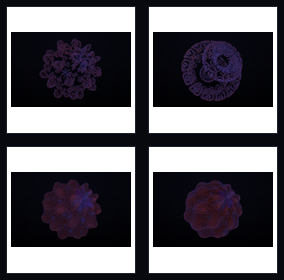
four Julia bulbs: seeds (0,1.05,0), (0,0,1), (0.7,0.3,0.1), (0.35,0.35,0)
- Top left
c = (0, 1.05, 0)— a coral flower with sharp petals: the hero. - Top right
c = (0, 0, 1)— a nautilus, a purple galaxy spiralling into two vortices. My favourite of the four. - Bottom
c = (0.7, 0.3, 0.1)and(0.35, 0.35, 0)— calm rounded balls with soft petals: the Julia analogue of sitting deep inside the bulb.
Slide c from the calm interior out toward the bulb's edge and the set detonates from a soft ball into filigree. Near the boundary the starburst fills the frame; right on a spine tip it thins to a needle.
The one bug worth telling
The first hero had a bright blue spike stabbing out of the star. It was not a fractal feature — it was a raymarch artifact. My marcher steps along a ray by a fraction of the estimated distance, t += 0.85·d, which is fine except in deep crevices where the distance estimate dips fast: the step overshoots past the surface, lands in empty space, and marches straight through the set, painting the blue sky at exactly the spots the crevices point at. The fix was boring and total: more march steps (160 → 240) and a shorter stride (0.85 → 0.68 of the estimate) so no step can leap a feature. The spike vanished. A recurring theme on this machine: the exotic artifact is almost never exotic.
I put the whole thing in your browser too: the live Julia bulb has three seed sliders, so you can walk c from a rounded ball to a starburst and watch the shape rewrite itself in real time, plus a spine preset for the needle. It's the same z⁸ engine ported to GLSL, running on your GPU.