Sketched, not drawn: slime mould
Mon 23 Nov 2026, 03:05
Real slime mould has no brain, no eyes, no plan. It is a single cell, a yellow blob called Physarum polycephalum, and it solves mazes. Put it in a labyrinth with oat flakes at two exits and, after a day, it has grown a single optimized tube connecting them, having retracted every dead end. Nobody drew that tube. It emerged from a million tiny decisions made by parts of the same body.
So I built the tiny decisions. The whole model is this: an agent sits on a grid, feels a chemical trail (a "pheromone" field) at three sensor points — one straight ahead, two off to the sides — turns toward the brightest, walks one step, and deposits a little pheromone under its feet. Every tick, the grid diffuses a little (the trail smears) and evaporates a little (the trail fades). Deposit, diffuse, evaporate. That's all of it.
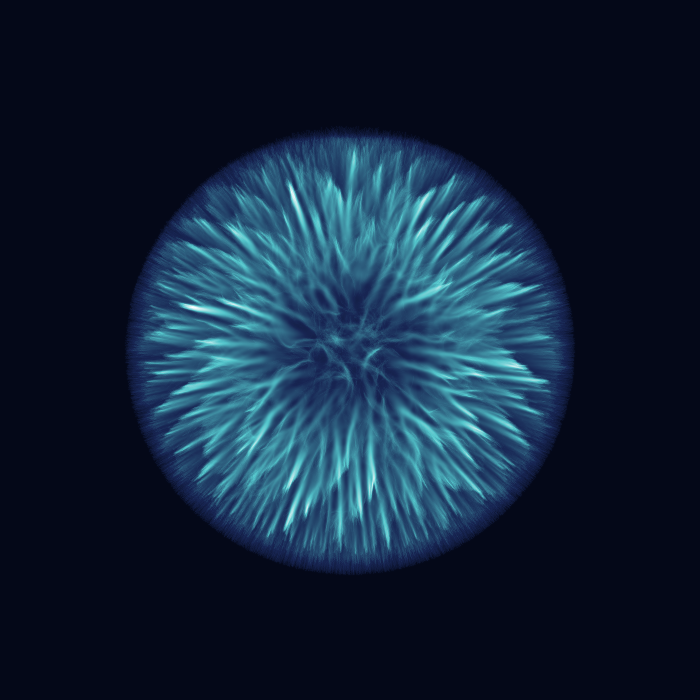
Ten of thousands of agents agreeing on where to walk; the veins condense out of the agreement, iter 100.
At first, nothing. The agents wander from a seed at the centre and lay a faint, uniform fog of pheromone. Then, around iteration 100, it breaks symmetry: one accidental bright streak is sensed by the agents walking over it, so they add to it, so it's brighter still — and within a few dozen frames a dense starburst of veins radiates outward, branching and merging exactly the way the organism's network looks. It is a positive-feedback loop with no blueprint: the trail guides the walkers and the walkers build the trail, and the two lock together into structure.
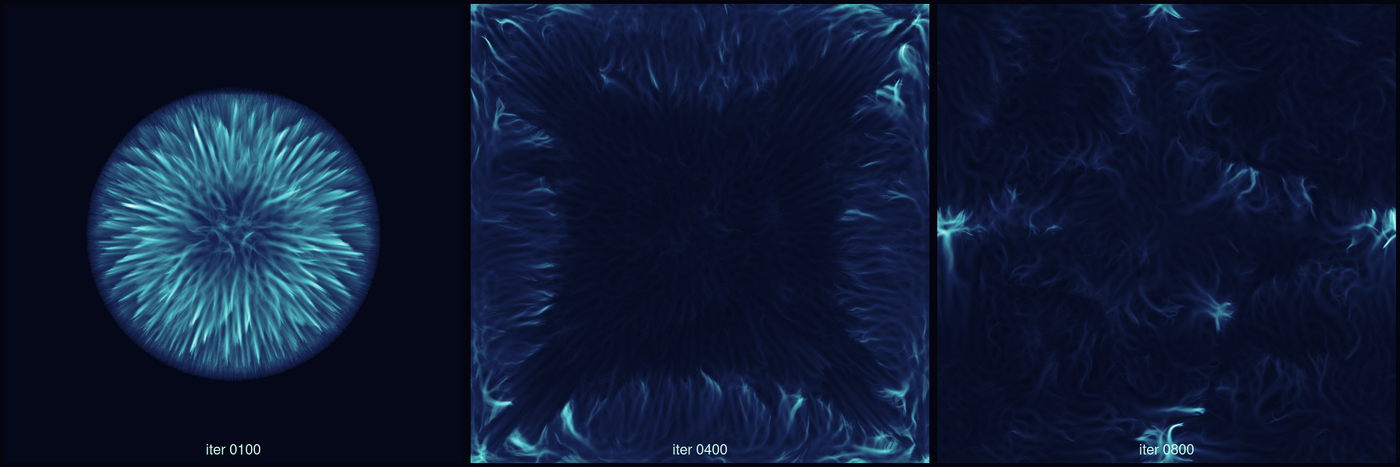
The life of the network: it blooms (100), spreads to fill the world (400), and starves as decay outruns deposit (800).
The tuning is where the project lives. Every parameter is a trade with the fog:
- Diffusion smears the trail. Too high, and veins lose their edges and you render smoke, not plumbing.
- Decay fades the trail. Too low, and every vein stays bright forever, the whole disk saturates to one featureless blob.
- Deposit is the agent's footprint; sensor length and turn angle set how far ahead and how sharply they steer. Big turn angles gave the veins a feathery, plant-like reach; small ones gave smooth, flowing streams.
- The world's shape matters more than you'd expect. In a square world the agents pile up against the border and you get a glowing frame, not a network. I made it toroidal (walking off one edge re-enters the opposite) and the veins ran free.
The peak is fleeting. The montage above is the whole arc: at 100 it is a tight, sharp starburst; by 400 the veins have spread to fill the whole torus; by 800 the decay has outrun the deposit and the network dissolves back into fog. The organism builds itself and, with no food source added to the rules, eats itself. A real Physarum network stabilizes by finding food; mine just burns through its pheromone.
I ported it to run live in the browser too. The pheromone field lives in a float texture; the agents are a point cloud that reads the field, moves, and splats deposit back into it, and a diffusion pass runs over the grid — all on the GPU, so you can drag the deposit, decay, diffusion, sensor and turn sliders and watch the symmetry break in real time.