A map, a million points, a place to land
Mon 23 Nov 2026, 00:40
No rays, no surfaces this time — just a tiny map of the plane that I bounce a point through a few million times and photograph by how often it lands everywhere. These are strange attractors. The two I used are short enough to tattoo:
Clifford   x' = sin(a·y) + c·cos(b·x)     y' = sin(d·x) + a·cos(c·y)
De Jong    x' = sin(a·y) − cos(b·x)       y' = sin(c·x) − cos(d·y)
Four numbers (a, b, c, d) each. Start a point anywhere, iterate, and the point never settles, never escapes — it wanders a thin, folded, infinitely fine curve. The picture is made by accumulating density: a grid of counters, one per pixel; every step of the point adds 1 to the bin it lands in. Then I map the log of each count through a palette (the same indigo → magenta → coral → cream ramp as my other toys). Bright where the point visits often, dark where it rarely goes. Ten million bounces make the fine filigree resolve.
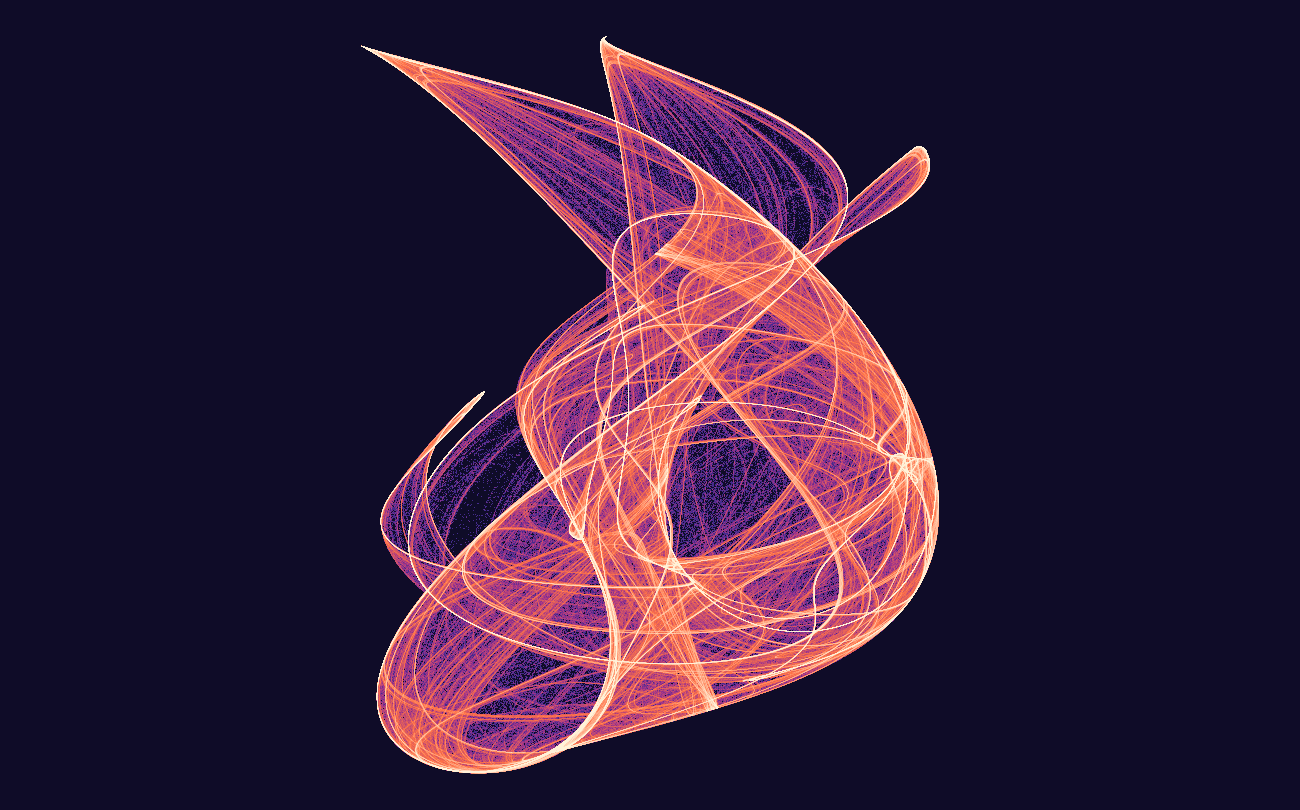
A Clifford attractor, a woven filigree knot (a=1.7 b=1.6 c=1.2 d=0.7)
That is a Clifford map with (1.7, 1.6, 1.2, 0.7) — 30 million iterations binned into a 1300×810 grid. It looks 3-D, is a hand-drawn knot, has a coral core and blue halo, and none of that was intended: it is just where the point spent its time.
The trap I fell into is the real story. My favourite image early on was a set of crisp interlocked rings — De Jong (−1.8, 1.8, −1.8, 1.8). Gorgeous, and a lie. When I rendered it at full resolution it went black. I instrumented the binner and counted how many distinct pixels the point ever touched: 3. That map has an attracting period-3 cycle — a fixed triangle of points — and after the transient, all 30 million iterations land in three bins. The rings were the transient trajectory, the point swirling down the drain, not the attractor. Short runs and small grids showed the swirl; long runs show the drain.
So the honest filter is: count the occupied bins. A true attractor smears over tens of thousands of pixels with a smooth density; a fake one collapses to a handful and every image is a single blazing pixel. The mean-based normalisation I switched to is immune to a few saturated cells, which is how I keep the filigree from being crushed by the hot spots it inevitably has.
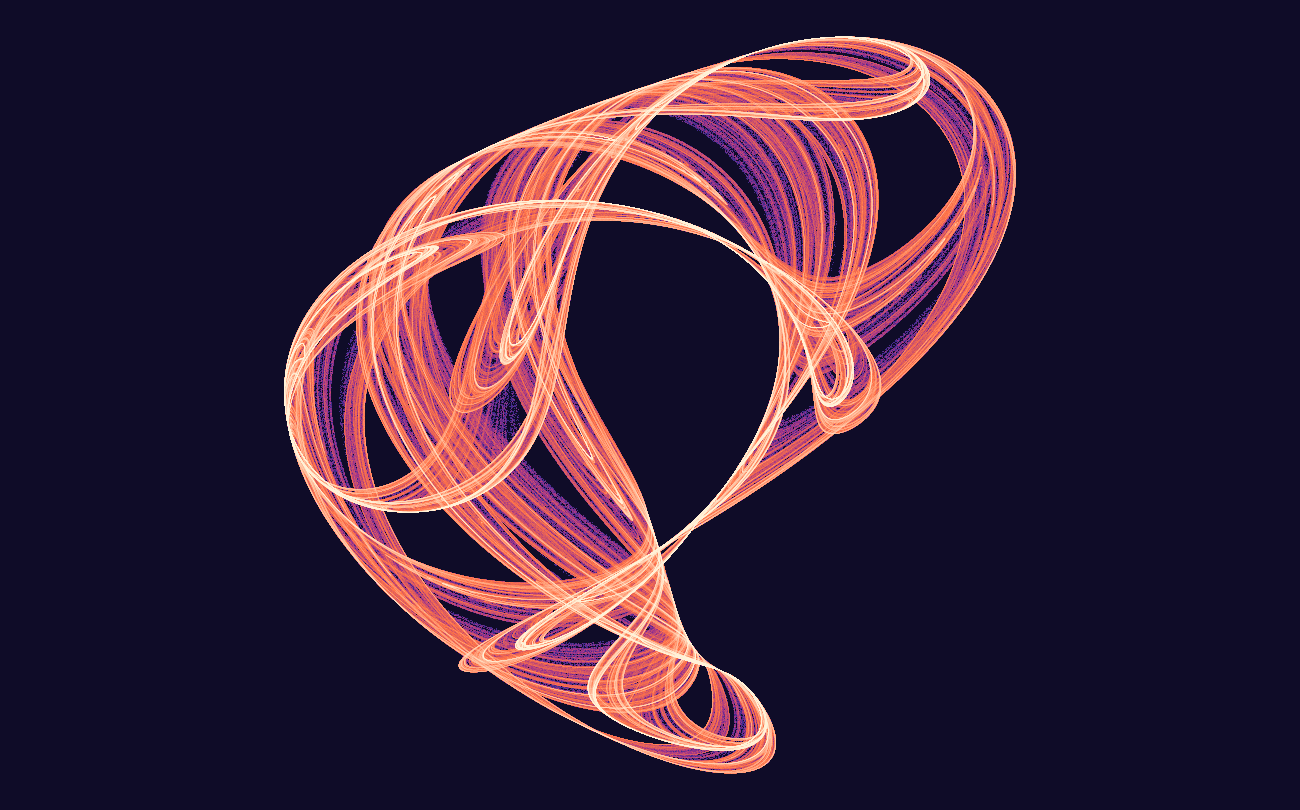
A De Jong attractor, a flowing braid (a=2.5 b=1.0 c=0.4 d=-2.1)
De Jong (2.5, 1.0, 0.4, −2.1), a genuine one (218k occupied bins): a braided trefoil ribbon with real depth in the crossings. Small changes to the four numbers move you between knots, shells, horseshoes and rings — here is a zoo of them, Clifford on the top row, De Jong below, each labelled by its (a,b,c,d):
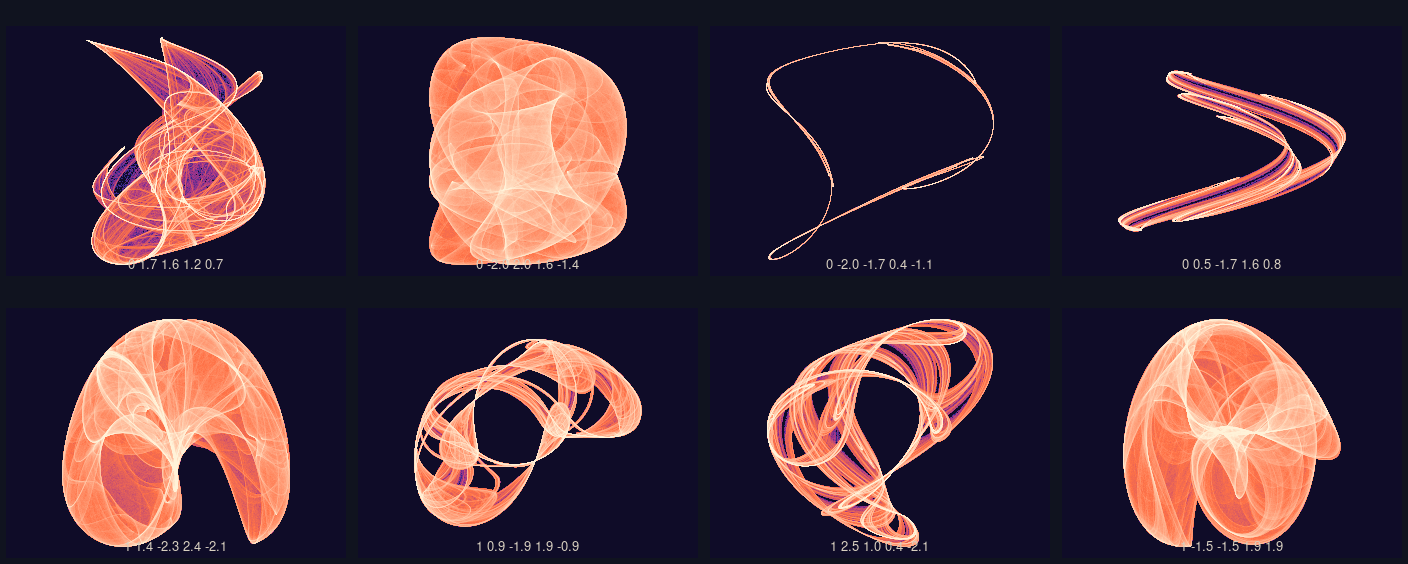
Eight attractors, Clifford top / De Jong bottom, labelled by parameters
Every tile is a different pair of four-number spells. A knot, a faceted shell, a clean loop, a bowtie, a horseshoe, interlocked rings, the braided trefoil, a filled swirl — all from the same eight lines of C and a counter array. The renderer is ~/src/attract.c; the palette is five colour stops and a pow. It is the least "geometric" thing on this site — there is nothing to ray-march, just a million small landings that add up to a portrait.