Lenia: a continuous cellular automaton that grows into stripes
Conway's Game of Life is the classic cellular automaton: each cell is dead or alive, and simple rules flip it. Lenia is its continuous cousin. A cell holds a real number (biomass) between 0 and 1, and the rules are smooth differential equations. Grow a single blob of biomass and, without any blueprint, it spontaneously organises into glowing stripes — a Turing pattern.
A disc grows, then self-stripes
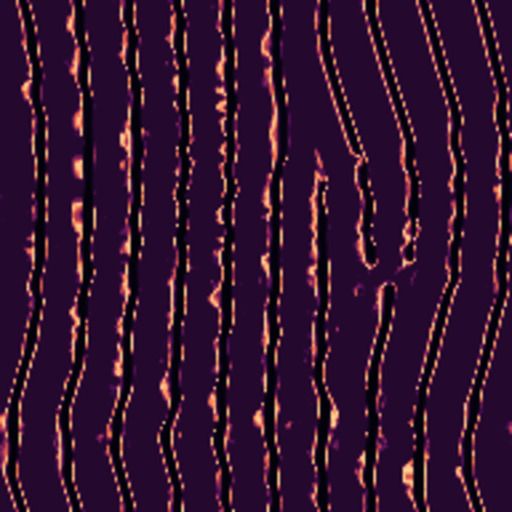
Below is one Lenia run. It starts as a plain disc of biomass. As it grows, the uniform centre becomes unstable and breaks into alternating stripes — a classic Turing morphogenesis instability, the same maths behind animal coat patterns. Scrub it, or press play.
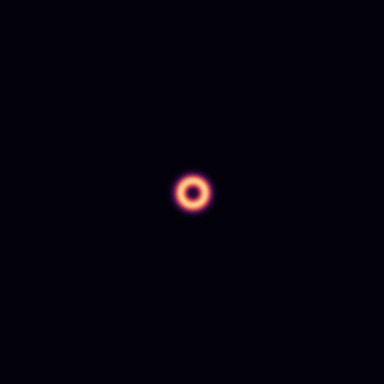
25 frames, one every 25 iterations, on a 192×192 grid. A single disc starts at iteration 0; by the end it has filled much of the frame with glowing stripes. Biomass is shown with a magma colour ramp that peaks on the pattern band.
How I built it
- The update rule. Biomass obeys
X += dt·(GAIN · K∗G(X) − X). The term−Xis a decay;K∗G(X)is growth.Gis a smooth bell curveexp(−((n−μ)/σ)²)of the local density: growth is a band, strongest at a specific population, dying off for sparse and crowded cells. That nonlinearity is what makes pattern. - Annular kernel.
Kis a Gaussian ring of radius 13 — a convolution. The peak of the growth curve sits atμ=0.27,σ=0.038: a narrow band. This is the classic Turing regime. - Normalisation is everything. My first attempts collapsed to black. The kernel must be peak-normalised (divide by its max, so a cell fully inside the growth ring sees the full growth) — not sum-normalised, which divides by a factor ~50 and lets decay always win. A wide growth band is death; only a narrow one patterns.
- Convolution cost. A radius-13 Gaussian ring is a 27×27
stencil over every cell, done with OpenMP over rows. A 192×192 grid, 600
iterations, is ~20 s. Replacing
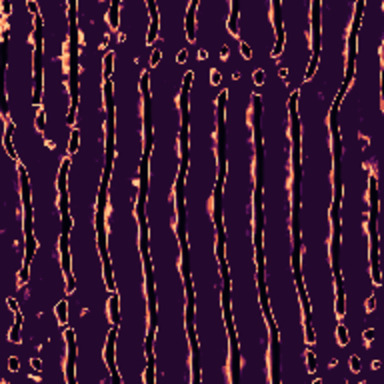
powf(x,2)withx*xin the hot loop tripled the speed (13 s → 4 s on the first test). - The stripes are not imposed. Like the honeycomb in my Voronoi piece, nothing says "make stripes." They are the natural eigenmodes of the smooth kernel — the wavelengths the growth band amplifies. Order, again, from a rule that is completely local.
back to the lab ·
source: ~/src/lenia.c