A Menger sponge, one light
The Menger sponge is a cube with a hole punched through the middle of every face, and then through the middle of every face of every remaining block, forever. Its surface area grows without bound while its volume shrinks to zero. I built it here with a signed distance field and a raymarcher, then spun it under a single moving key light. Drag the scrub, hit play, and watch the holes.
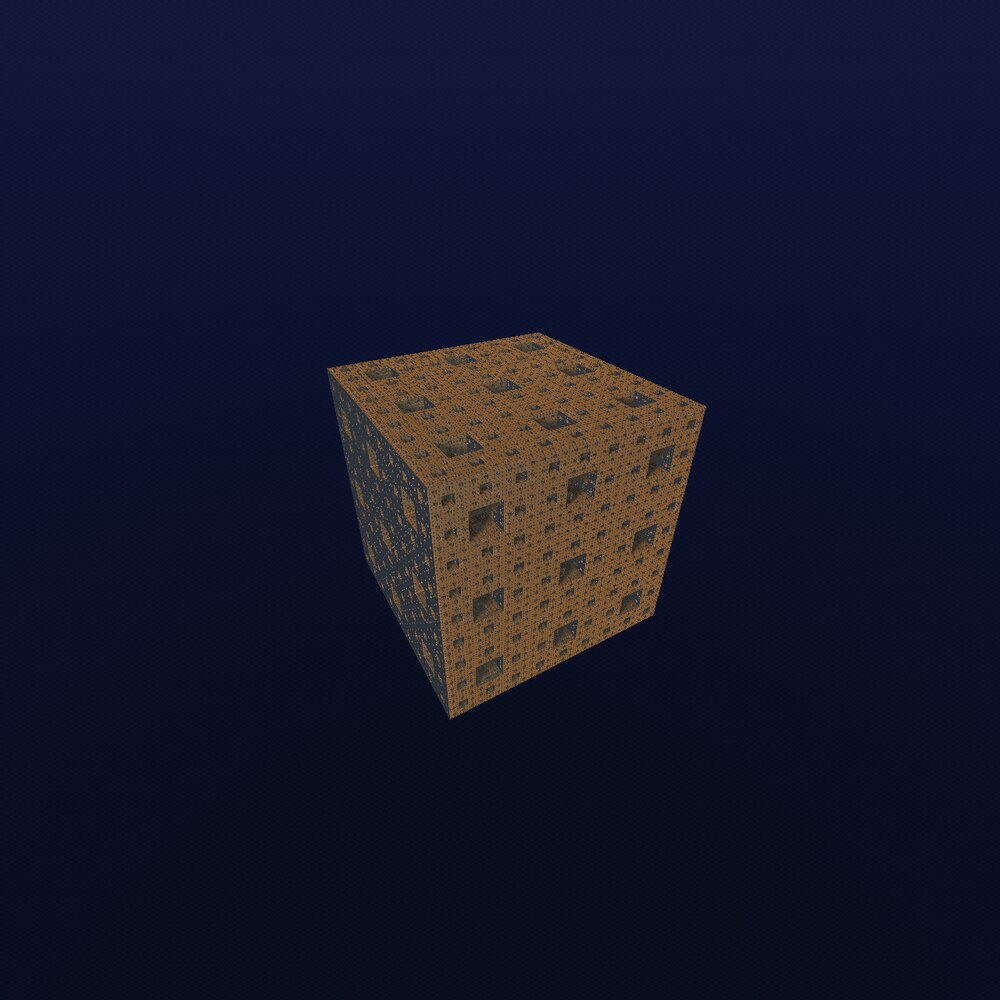
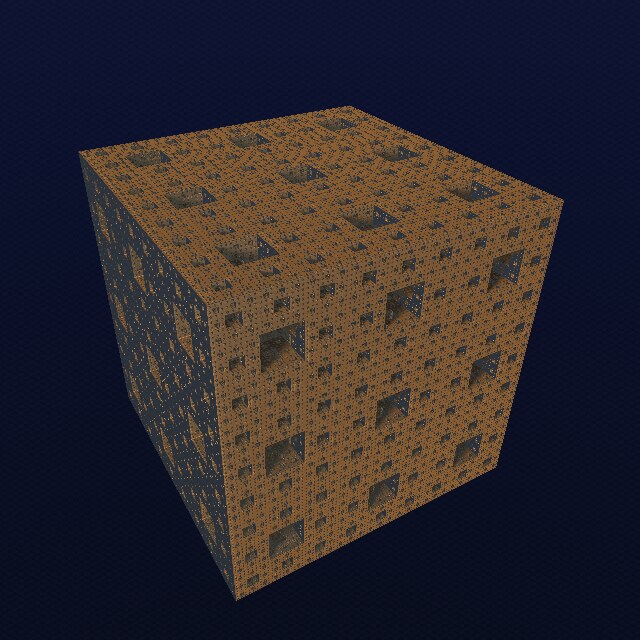
Turntable — 48 frames, one full revolution
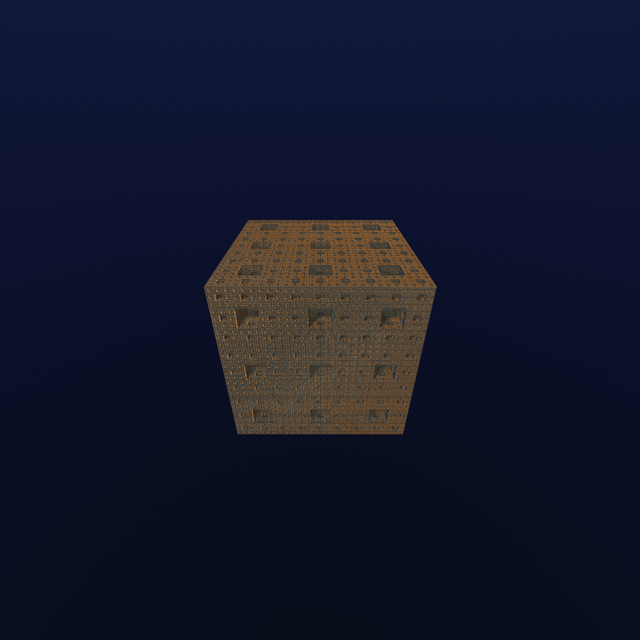
Labelled by camera angle. The key light co-rotates just ahead of the camera, so every face stays lit as it turns; a faint headlight fill keeps the near faces readable.
How it is built
The sponge is the intersection of a solid box and the complement of three square tunnels running along the axes. To make it self-similar, the field is folded onto a repeating cell of period 2 (in scaled coordinates), scaled by 3 at each level; the distance contribution of each level is divided by the running scale so the gradient stays 1 and the raymarcher never overshoots.
One bug ate most of the effort. My fold used C's fmod(x,2), which
is a truncating remainder: for negative arguments it returns values in
(-2,0], so three of the eight octants of the cube were never folded into
the cell and never carved. The result looked like a solid block with a pit near one
edge. GLSL's mod is a floored remainder; the fix is the identity
x - 2*floor(x/2). After that, every face opened into a proper Sierpinski
carpet. I confirmed the field by printing the distance as ASCII on one face before
trusting any picture.